
Between September 2025 and August 2026, a customer in Río Hurtado went an average of 147 hours without electricity supply. The national average was 17.5 hours. In Cunco it was 142; in Melipeuco, 138. At the other end, several municipalities in Santiago stayed under 4 hours.
Supply continuity data for 329 municipalities show a grid that works reasonably well on average and very badly at its edges. The technical standard already recognises those edges with density-based targets, but the public policy goal was once again set as a national average, and more than half of the hours without power are left out of compliance measurement as force majeure.
What is being discussed
The Ministry of Energy launched the participatory process for the Power Grid Reform, and its working group began on 29 September. The aim is to update the regulation of distribution and transmission, whose legal framework is more than 40 years old. The technical work is supported by the Infrastructure Policy Council and assistance from the World Bank.
The timeline is short. In December the ministry would present a conceptual proposal, and the bill would be sent to Congress by the first quarter of 2027 at the latest.
This is a new attempt to settle a long-standing debt of the sector. The last major proposal that led nowhere concrete: 2019, under President Piñera's second government. Part of the diagnosis already exists. In March 2026, an expert committee recommended smart meters, tariffs with time-of-use signals and paying for investment plans, not just for a “model company”. Industry associations are calling for long-horizon investment and more resilient grids. Several issues should be on the table, for example: deciding who is accountable when the weather strikes.
What the data show
Between 2012 and 2023, an average customer spent about 14.6 hours a year without power. In 2024 it was 27.6: winter storms pushed force majeure to 15.5 hours, more than half the total. In 2025 the figure fell to 20.9, but with a different signature: the nationwide blackout of 25 February sent external faults up to 8.6 hours. With that event out of the window, the last twelve months (September 2025 to August 2026) add up to 17.5 hours, and force majeure again accounts for more than half: 54%.
Chile's National Energy Policy (PEN), in its 2022 update, sets a 2050 target for average national unavailability to stay under one hour a year, with at most two events and less dispersion across municipalities than in 2021. For 2035, the interim target is four hours and five events. Today we are at 17.5 hours, or 8 excluding force majeure: either way, far from the interim target. The original version of the PEN aimed at something else: 1 hour “in any locality of the country”, although without counting force majeure. The update moved from every locality to the national average, and dispersion across municipalities was left as a goal without a number.
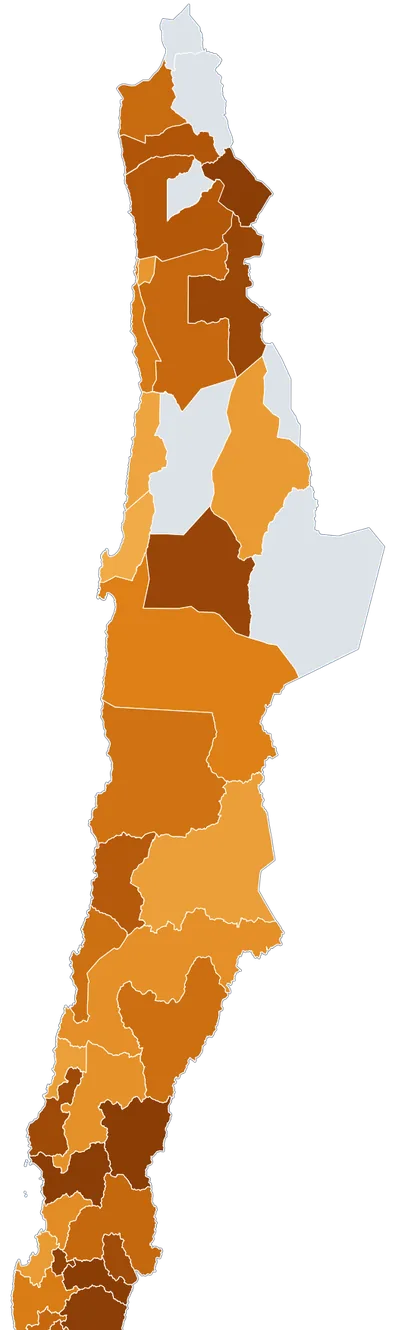
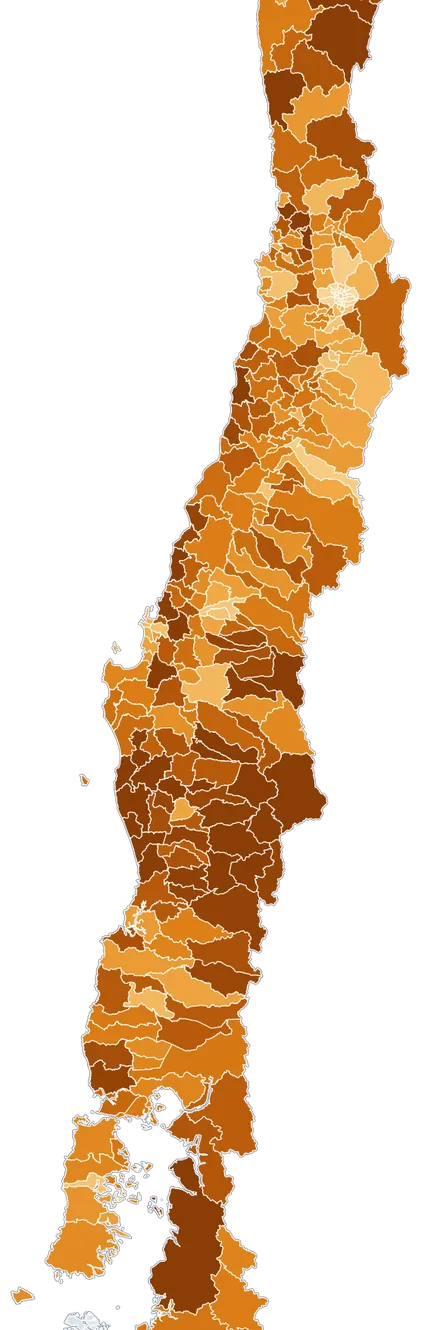
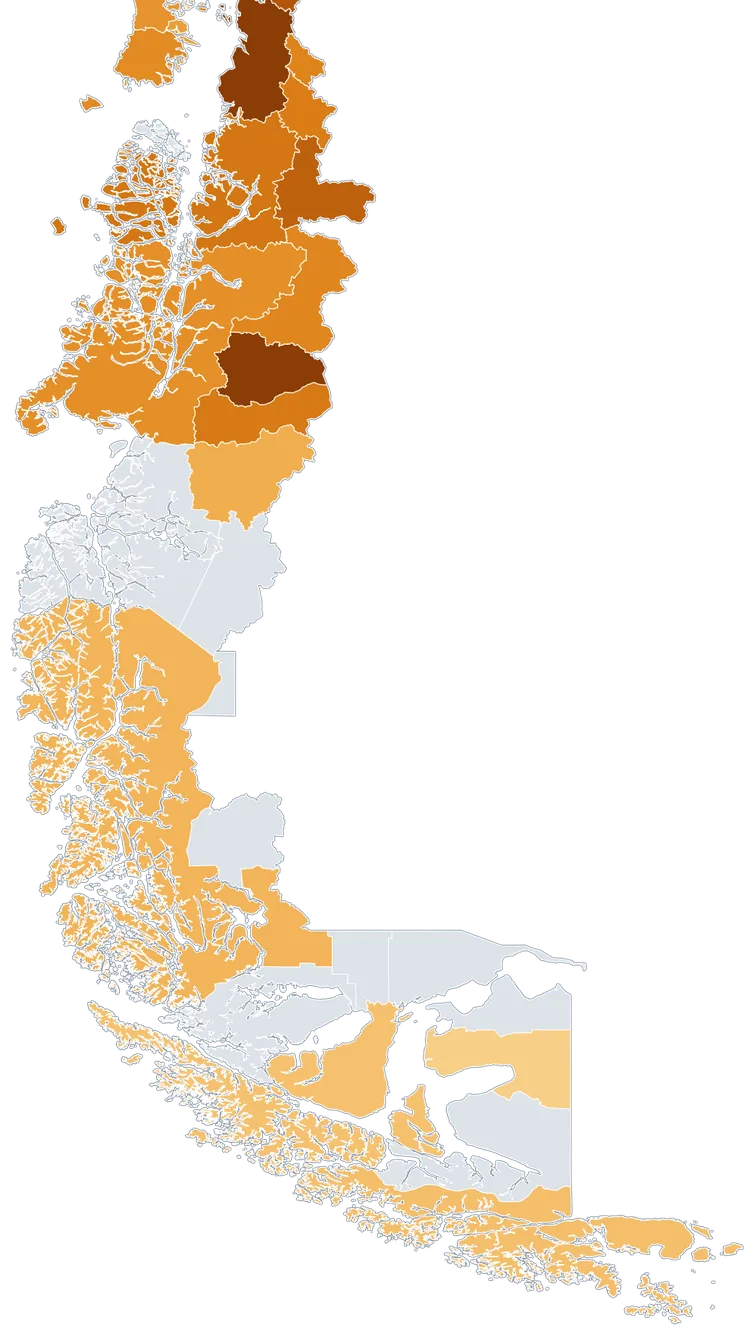
Hours without power per customer, last 12 months
Light = few hours
Strong = many hours
No SEC data
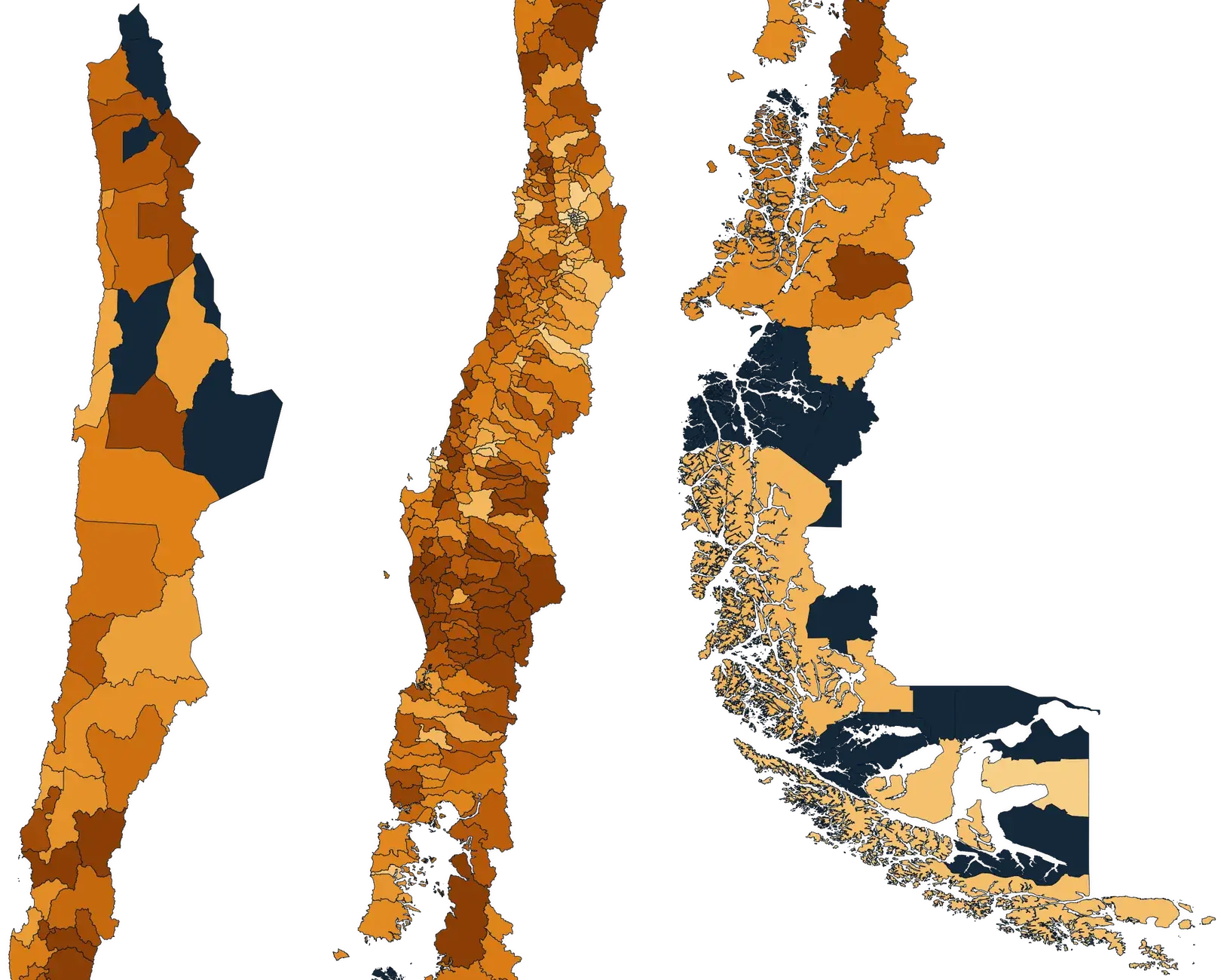
The average also hides geography. Over the last twelve months, the median municipality had 21.8 hours and the worst-affected 10% exceeded 58 hours. By region, La Araucanía accumulated 46 hours and the Santiago Metropolitan Region, 7. The worst figures cluster in rural municipalities of La Araucanía (Cunco, Melipeuco), inland Coquimbo (Río Hurtado, La Higuera) and the Tarapacá highlands (Colchane). Many of them are also low-income. These are territories with long networks and few customers per kilometre, where each fault costs more hours.
Is force majeure what explains that gap? Not entirely. In the worst-affected 10% of municipalities (33 municipalities, some 270 thousand customers), force majeure weighs almost the same as in the rest of the country: 56% of the hours, versus 53%. And if it is taken out, the gap remains: 36 hours against 7. Even by the yardstick regulation uses today, these municipalities are far from any target.
Here there are two diagnoses that call for different answers. Where force majeure dominates, the question is what storm the grid should withstand. Where the grid's own faults dominate, no debate about force majeure will change the map: the problem is performance.
What will we keep calling force majeure?
Regulation does not establish which events may be treated as force majeure: it leaves that decision to the Superintendency of Electricity and Fuels (SEC), case by case. The distribution company submits evidence and, if the SEC accepts it, the SEC sets the nature of the event, its duration, its extent and which standards are waived. Those hours are removed from the calculation used to measure compliance with the various indicators (SAIDI and SAIFI), together with those that occurred during an Abnormal State.
The problem is one of scale. Between 2012 and 2023, force majeure accounted on average for 41% of the hours without power. In 2024 it was 56%; over the last twelve months, 54%. July 2026 alone concentrated 41% of the force majeure of those twelve months. When a type of event recurs winter after winter, it stops being unforeseeable and becomes a design condition.
The reform could bring order with a simple rule: set climate design standards by zone (wind, snow, temperature, wildfire risk) and classify as force majeure only what exceeds them. Everything else is grid performance. Every classification should be public, with the detail the standard already requires. Another option is a statistical threshold: only the days whose level of interruptions clearly exceeds the network's own historical distribution are excluded.
Public information on the origin of force majeure matters. Historically, vehicles crashing into electrical installations have accounted for a significant share of these events, so understanding how the impact of climate on force majeure events evolves, where it falls and what it does to our distribution networks will be crucial.
How do we prepare the grids?
Chile has some 100 thousand kilometres of medium-voltage lines, and 98% of them are overhead. It is a network exposed to wind, snow, trees and fire.
There are several tools for dealing with events on the distribution network. The difficulty lies in designing regulation that recognises them and that balances the level of security against the cost of a more resilient grid, among others:
- Resilience plans by feeder, starting with those that fail most and not with regional averages.
- Vegetation management with standards and enforcement, because it is the most frequent cause during storms.
- Covered conductors and selective undergrounding where the risk justifies it, not as a general rule.
- Automation and sectionalising, so that a fault leaves hundreds of customers without power rather than thousands.
- Microgrids and storage in isolated municipalities.
- Smart metering and an up-to-date asset inventory, because you cannot plan on a register that is updated so slowly.
None of this moves forward if the tariff scheme does not pay for investment in resilience or tie that pay to verifiable results.
What does inaction cost?
With an average of 17.5 hours and some 8.5 million customers, the country accumulated close to 150 million customer-hours without supply last year. About 81 million of those hours fell under force majeure and were therefore left out of compliance measurement. For the standard, they never happened. For homes and businesses, they did.
The short-duration outage cost calculated by the CNE (2025) gives a reference. It ranges from US$4 to US$13 per kWh not supplied, depending on how long the interruption lasts —tens of times the cost of energy. Every hour of outage in a supermarket, a clinic or an irrigation plant costs far more than the electricity that failed to arrive.
If the grid does not adapt, climate change will make that figure grow, and the investments postponed today will be paid for later, as emergency replacement and compensation.
Pay for performance, not just for assets
Today service quality sits between two institutions with different goals. The CNE sets the distribution value added on the basis of an efficient model company, with the natural incentive to lower the tariff. The SEC enforces continuity standards with fines and compensation. Neither of them puts a price on quality. The risk: tighter tariffs, networks with less headroom and quality that is corrected afterwards, with penalties, instead of bought beforehand, with investment.
One alternative is to make part of the distribution company's revenue contingent on performance: a reward if it brings hours without power below a target and a penalty if it exceeds it. The value of each avoided hour does not need to be invented; the outage cost the CNE already calculates is a natural reference. The tariff would then state explicitly how much one hour less of outage is worth to the country.
The instrument has two conditions. First: today, an hour classified as force majeure already avoids fines. If it also stops reducing revenue, each classification is worth more money and the pressure to obtain it grows. Defining in advance what counts as unforeseeable becomes a necessary rule for the scheme to work.
Second: with a single target, the scheme would punish rural networks and reward urban ones. Chile already has the piece to prevent that. The distribution technical standard classifies each municipality–company pair by the density of its network, from high to extremely low, and sets a SAIDI standard for each category: in the 2024 version, 5 hours a year for high density and 14 for extremely low. Cunco is in the latter. Yet its internal faults alone added up to 84 hours over the last twelve months, six times its standard. What is missing is not a differentiated target, but for missing it to have a proportional effect on revenue.
There is also a political question. The standard tolerates almost three times as many hours without power in Cunco as in Santiago. Is that difference a point of arrival or a starting point, and who pays for closing that gap? Chile already decided to narrow price differences between territories with the Tariff Equity Law. Should we expect the reform to take the same path with service quality?
Open questions
The working group is just getting started, and its merit will depend on the questions it dares to answer. On the particular topic addressed here, the data put at least three on the table.
Where does the unforeseeable end? Today force majeure is decided case by case and after the event. The alternative is to set in advance what wind, snow or heat the grid must withstand in each zone, and to call force majeure only what exceeds that threshold. But thresholds age with the climate. Who sets them, with what evidence and how often are they reviewed?
How much resilience do we want to pay for? A grid that never fails is unaffordable. One that fails every winter also has a cost, even if it does not show up on the bill. The optimum is not the same in Santiago as in Cunco, where there are few customers per kilometre and each fault lasts longer. The standard already recognises that difference with density-based targets. What is not settled is who pays for additional resilience in rural areas: their own customers, through higher tariffs, or the whole system.
What happens when everything depends on electricity? The transition electrifies heating, transport, cooking and water pumping. An hour without power in 2035 will cost much more than today, and households with self-generation and batteries will be able to ride it out better than the rest. In the municipalities that today spend more than a hundred hours a year without power, electrifying heating or cooking is not a real option, but rather a utopia. Do we design the grid for yesterday's demand or for that of an electrified economy? How do we keep resilience from becoming a privilege of those who can pay for it?
A customer in Río Hurtado went 147 hours without power; for the standard, 140 of them never happened. One in Cunco had 84 from the grid's own faults, six times what the standard requires. How do we make sure the reform addresses both situations?